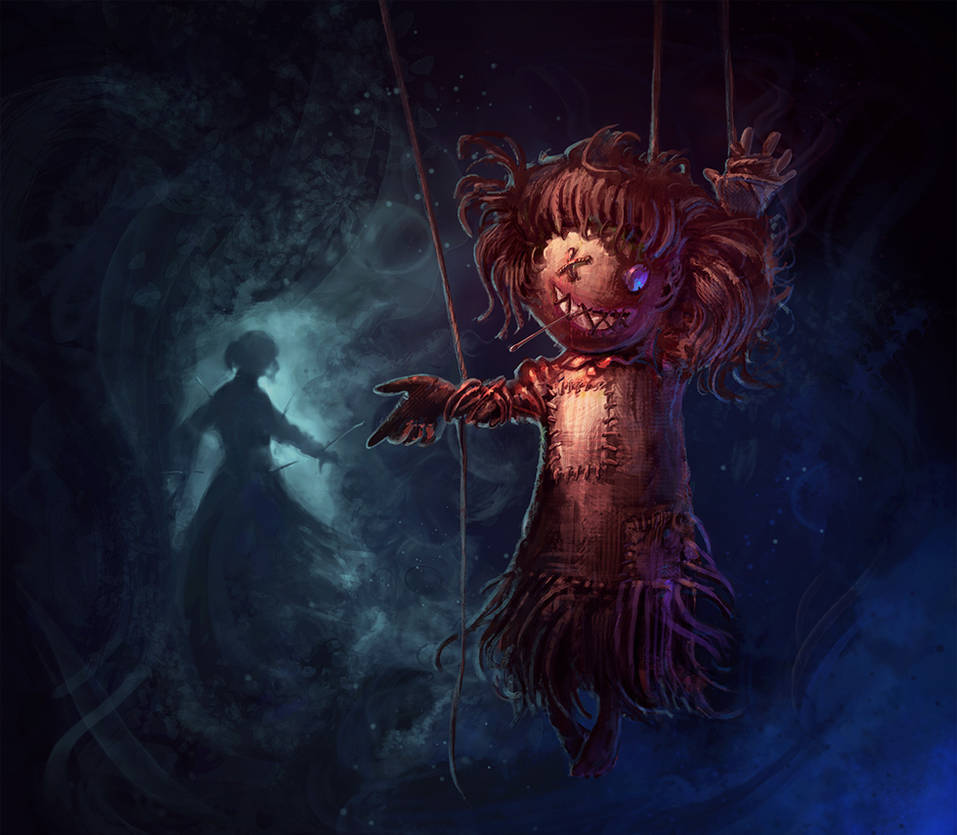
voodoo dollby Lelyk777, 2013. CC BY-ND 3.0. Unmodified.
Witch Subclass: Poppet Master
Witches of this tradition bind poppets, small dolls linked to living flesh by taglocks, and work through them at a distance: scouting, hexing, and casting the beneficent and maleficent effigy rituals without standing in the open. Many come to it through folk magic or hedge practice; others after someone else’s likeness took a blow meant for them.
Unofficial homebrew. Requires the Witch class from Tales of the Valiant Player’s Guide 2—Hex, coven spells, and ritual rules are in that book.
Poppet Master features
| Witch Level | Features |
|---|---|
| 3rd | Poppet Master Coven Spells, Poppet Ritualist, Sympathetic Harvest |
| 7th | Spirit-Stitched Effigy |
| 11th | Spirit Effigy Mastery |
| 15th | Sympathetic Effigy |
Poppet Ritualist
3rd-Level Poppet Master feature
You learn the beneficent effigy and maleficent effigy rituals (Player’s Guide 2, pp. 226, 234). These do not count against the number of rituals you know. If you already know either ritual, choose a different witch ritual to learn in its place.
- Beneficent effigy. You craft a doll linked to an ally (using a body part or keepsake); while you hold it, you can Help them at range, cast wyrd spells on the bound ally through the poppet, or divert half of an attack’s damage into the poppet.
- Maleficent effigy. You craft a doll linked to a foe (using a body part or keepsake); while you hold it, you can cast wyrd spells on the bound foe through the poppet, damage the doll to deal typed damage to the target, or wrench it to impose disadvantage on their attacks and Strength or Dexterity rolls.
Full casting time, components, and effects are in Player’s Guide 2. The Cast Spell Through the Poppet rules below replace the Cast Spell option from those rituals when you use a bound poppet.
A poppet moves through three steps: prepare an empty doll, bind it to a creature with a taglock, then use it for the effigy ritual’s effects.
Poppet. A poppet is a small doll you shape from clay, mud, wax or other materials to receive a taglock and carry a beneficent effigy or maleficent effigy ritual. An unbound poppet has no taglock and no target. A bound poppet is linked to one creature and carries an active effigy ritual. A bound poppet is notoriously easy for the creature bound to it, or for anyone with a sympathetic link to that creature, to locate with divination magic unless protective measures are taken.
Preparing Poppets. As part of a short or long rest, you can prepare a number of unbound poppets from clay, mud, or wax equal to the number of times you can use your Hex feature when you finish the rest. You form each poppet without placing a body part or personal possession in the material. An unbound poppet remains until it is lost or destroyed.
Taglock. A taglock is blood, skin, hair, or other material from a creature that satisfies the body part or personal possession material component of the beneficent effigy and maleficent effigy rituals. When you have a taglock attuned to a creature in your possession, you have such material from that creature on your person.
Taglock Freshness. A taglock’s sympathetic link fades over time depending on what it is:
- Hair or skin remains attuned for 1 week after it is taken from the creature.
- Blood remains attuned until it dries. You or any creature proficient with alchemist’s supplies can preserve a blood taglock in liquid form as part of a short rest. While preserved this way, it does not dry and remains a valid taglock.
- Other keepsakes remain attuned for as long as their bond to the creature lasts, as determined by the GM. An engagement ring might remain attuned for a lifetime; a child’s stuffed toy might fade when they outgrow it.
You can’t use a taglock that has lost its sympathetic link to bind a poppet or cast the beneficent effigy or maleficent effigy ritual.
Binding a Poppet. While you are holding an unbound poppet, you can bind it as a bonus action. You must have a taglock attuned to the creature in your possession that has not lost its sympathetic link (see Taglock Freshness). When you bind the poppet, you expend that taglock, link the poppet to that creature, and cast the beneficent effigy or maleficent effigy ritual on it. The casting time for the ritual is that bonus action. This satisfies the body part or personal possession component required by the ritual. You choose which ritual you are casting when you take this bonus action.
You can have a number of bound poppets with an active effigy ritual equal to your proficiency bonus at a time. If you bind a new poppet when you are already at this limit, choose one of your other bound poppets; its effigy ritual ends immediately, the poppet crumbles, and it loses its sympathetic link to the creature it was bound to.
Using a Poppet. While you hold a bound poppet, you can use that ritual’s effects from Player’s Guide 2 (Assist, Divert Pain, Cause Pain, Spasm, and the like). Most of those effects require you to hold the poppet and keep the target within the ritual’s range.
Extending the Ritual. If you are holding a poppet already bound to a creature, you can cast the beneficent effigy or maleficent effigy ritual on that creature again as a bonus action instead of 1 minute to refresh the ritual’s duration without binding a new poppet. When you do, that creature must make a WIS save against your spell save DC. On a failed save, the ritual’s duration is refreshed. On a successful save, the ritual is not extended and the poppet crumbles, losing its sympathetic link. A willing creature can choose to fail this save.
Cast Spell Through the Poppet. When you use the Cast Spell option of a beneficent effigy or maleficent effigy ritual on a creature bound to one of your poppets, use these rules instead of the Cast Spell option in Player’s Guide 2.
The bound poppet and the target creature must share a plane of existence. You don’t need the target to be within the ritual’s range. You don’t need to hold the poppet; another creature you trust (such as your sympathetic effigy) can hold or carry it for you.
You can cast any wyrd spell you know on the poppet as if the poppet were a valid target for that spell, and the spell affects the creature bound to that poppet via the effigy. For a beneficent effigy, the spell must be one that benefits the bound creature. For a maleficent effigy, the spell must be one that harms or hinders the bound creature.
When you cast the spell this way, use the poppet in place of the target for any requirement of the spell:
- If the spell requires you to see the target, you need only see the poppet.
- If the spell requires the target to hear you, the poppet need only be within the sound of your voice.
- If the spell requires you to touch the target, you need only touch the poppet.
You must still meet any other requirements to cast the spell, such as components, concentration, and spell slots.
Sympathetic Harvest
3rd-Level Poppet Master feature
You can harvest a taglock through your hexes. When you use your Hex feature to give a creature a Hex die, you can force that creature to make a CON save against your spell save DC as part of the same bonus action (you can’t use the Hex die to reduce this save). If the creature is unaware of you, it has disadvantage on this save. An unconscious creature automatically fails. Each time that creature starts its turn with a Hex die from you, you can force the same save again (no action required). On a failed save, you gain a taglock attuned to that creature in your possession. On a successful save, the creature realizes a sympathetic link was attempted against it and has advantage on Perception checks to spot you until the end of its next turn.
If you use your Hex feature through a spirit effigy, you don’t gain the taglock in your possession on a failed save. Instead, the spirit effigy holds that taglock until it delivers it to you.
When you gain a taglock through this feature, the GM determines what material you receive based on how easily it could be gathered from the target in the moment. For example, you might receive a few strands of hair or a scrap of shed skin rather than fresh blood; blood is unlikely unless the creature is already bleeding from an open wound or has wet blood on them that has not yet dried.
Poppet Master Coven Spells
3rd-Level Poppet Master feature
You gain coven spells at the witch levels listed in the Poppet Master Coven Spells table. See the Witch Subclass class feature for how these spells work.
| Witch Level | Spells |
|---|---|
| 3rd | bane, bless, hold, warding bond |
| 5th | bestow curse, remove curse |
| 7th | compulsion, death ward |
| 9th | dominate, greater restoration |
Spirit-Stitched Effigy
7th-Level Poppet Master feature
You can invite spirits into spirit dolls, separate from the poppets you prepare for effigy rituals. Spirits are embodiments of purpose and ideal, not creatures, souls, or Undead, as described in the Witch class.
Creating Spirit Dolls. Over 10 minutes, you can create an inanimate spirit doll from clay, mud, wax or other material. You can have a number of inanimate spirit dolls you created with this feature equal to your proficiency bonus (rounded down). Any inanimate spirit dolls you create after you have already reached this cap replaces the oldest inanimate spirit doll you created with this feature. An inanimate spirit doll remains until it is lost or destroyed.
Animating a Spirit Effigy. As an action, you can animate one inanimate spirit doll with a touch, binding a beneficent or malevolent spirit into it. When you do, choose whether the spirit is beneficent or malevolent. The animation lasts for a number of hours equal to your proficiency bonus or until it is destroyed or the magic is dismissed, as described below. You can only have a number of spirit effigies equal to half your proficiency bonus (rounded down) animated at any given time. If you animate more than this number, you must first dismiss one of the previously animated spirit effigies. You can animate a spirit effigy a number of times equal to your proficiency bonus (rounded down) each time you finish a long rest.
Your Spirit Effigy. A spirit effigy is a Tiny animated doll. It is considered a Construct for any relevant spells and effects. Its AC equals your spell save DC, and it has a number of hit points equal to 5 + your witch level + your proficiency bonus. It has a walking speed of 60 feet and a climbing speed of 60 feet, and it has no swim speed. It has darkvision out to 60 feet. It can hold, carry, and manipulate objects weighing up to 5 pounds. It can’t take the Attack or Cast a Spell action except when gathering a taglock or as allowed by its beneficent spirit, malevolent spirit, and Spirit Effigy Mastery actions. A creature can’t perceive a spirit effigy using keensense.
Effigy Resilience. The spirit effigy is immune to poison and psychic damage. It has resistance to bludgeoning, piercing, and slashing damage from nonmagical attacks. In addition, it is immune to exhaustion and to the charmed, frightened, paralyzed, petrified, and poisoned conditions.
Repairing an Effigy. A spirit effigy regains HP only when a creature casts the mending cantrip on it. When a creature does so, the spirit effigy regains a number of HP equal to your spellcasting ability modifier (minimum of 1).
Planar Link. A spirit effigy functions normally while you or your sympathetic effigy share a plane of existence with it. While you share its plane, it conveys what it senses to you and you can command it telepathically. When only your sympathetic effigy shares its plane, it commands that spirit effigy as you would. If neither of you shares its plane, the spirit effigy becomes inert until one of you does. Its animation continues until its duration ends or it is destroyed.
Speak Through the Effigy. While your spirit effigy can convey what it senses to you, you can speak through it. Creatures within 10 feet of the spirit effigy hear your voice as if you were there, using your normal voice unless you are otherwise disguising your voice. Speaking through the effigy requires no action from you.
Following Commands. A spirit effigy can understand simple spoken or telepathic instructions and act on its own to carry them out. For example, it can fetch an object you describe, wait at a location, count things it can see, watch for a condition you name, or report what passes through an area. It uses its movement and actions to complete the task until the task is finished, its animation ends, or you give it a new command. If a task depends on a trigger, such as waiting until a cart passes or until someone enters a road, the spirit effigy can take the Ready action when appropriate and convey what it senses to you when the trigger occurs. A spirit effigy can’t follow commands that would require it to take the Attack or Cast a Spell action, and it isn’t clever enough to complete complex plans, solve puzzles, or interpret orders beyond what the GM agrees is simple.
When the spirit effigy takes the Hide action, it makes a DEX (Stealth) check. The total of the check equals your spell save DC instead of rolling. It has advantage on this check if it is in an area of dim light or darkness.
Actions in Combat. Your spirit effigy obeys your commands. In combat, it acts on the same initiative count as you, taking its turn immediately after yours. On its turn, it can move up to its speed. If you haven’t telepathically commanded it to do otherwise, it takes the Dodge action. You can telepathically command it to take a different action instead, including the Dash, Disengage, Help, Hide, Ready, Search, or Use an Object action, or any action granted by its beneficent spirit, malevolent spirit, or Spirit Effigy Mastery feature. Issuing or changing this command requires no action from you.
Gather Taglock. When the spirit effigy is within 5 feet of a creature, it can use its action to gather a taglock from that creature. It makes a melee spell attack against the target’s AC using your spell attack bonus. It has advantage on the attack roll if the target is not in combat or if the spirit effigy is hidden from the target. An unconscious creature is treated as if the attack hit. On a hit, the spirit effigy gathers a taglock and holds it until it delivers it to you. It can hold only one taglock at a time. If the spirit effigy is hidden from the target, a successful Gather Taglock doesn’t reveal the effigy; on a miss, the target notices the attempt.
Deliver Taglock. When the spirit effigy is within 5 feet of you, it can take the Use an Object action to deliver a taglock it holds to you. You gain a taglock attuned to that creature in your possession.
Ending the Animation. If your spirit effigy drops to 0 HP, the spirit departs and the doll crumbles. As an action, you can end the animation on a spirit effigy. When the animation ends, the spirit departs and the doll crumbles.
Beneficent Spirit. A spirit effigy animated with a beneficent spirit can take the following actions when it takes an action:
- Bandage. It administers aid to a creature within 5 feet of it. It can expend one use of a healer’s kit it carries to stabilize a creature that has 0 HP without needing to make a WIS (Medicine) check.
- Administer. It gives a beneficial potion you gave it to a creature within 5 feet of it, and that creature gains the potion’s normal benefit and the potion is consumed.
- Mend. It touches a willing creature within 5 feet of it. That creature can use its reaction to expend one Hit Point Die and regain HP equal to the normal hit dice roll + your spellcasting ability modifier.
- Restore. It touches a willing creature within 5 feet of it and ends one disease or one condition afflicting that creature, as with the restoration spell. The condition can be blinded, deafened, paralyzed, or poisoned. A creature can benefit from Restore from your spirit effigy only once per long rest. The spirit effigy then becomes inanimate and the animation ends.
Malevolent Spirit. A spirit effigy animated with a malevolent spirit can take the following actions when it takes an action:
- Unlatch. It is proficient with thieves’ tools. It makes a DEX (Thieves’ Tools) check using your spellcasting ability modifier to unlock a nonmagical lock or unbar a door or window. On a failed check, its tiny implements break in the attempt, and it can’t take the Unlatch action again until you animate a new spirit effigy.
- Filch. It makes a DEX (Sleight of Hand) check using your spellcasting ability modifier contested by the target’s passive Perception. On a success, it takes one Tiny object the target carries that you can see.
- Poison. It delivers a dose of poison you gave it to a creature or object within 5 feet of it. The poison takes effect according to its type (contact, ingested, inhaled, or injury), as described in the rules for using poison.
- Hex. On your turn, you can use your Hex feature through the spirit effigy. This counts as the spirit effigy’s action. Choose a creature within 60 feet of the spirit effigy, other than yourself, that the effigy can see. That creature gains one Hex die, as with your Hex feature. You can then force the save from your Sympathetic Harvest feature. On a failed save, a taglock attuned to that creature is held by the spirit effigy until it delivers it to you with Deliver Taglock.
Spirit Effigy Mastery
11th-Level Poppet Master feature
Your spirit effigies can use Empower, Refresh, Renew, Drain, Slow, and Diminish. A creature or object can be affected by only one of those options once per long rest. You can direct your spirit effigies to use them a combined number of times equal to your proficiency bonus (rounded down) each time you finish a long rest. When the spirit effigy uses one of them, it then becomes inanimate and the animation ends.
Beneficent Spirit. A spirit effigy animated with a beneficent spirit gains the following options on its turn:
- Help. It can take the Help action as normal.
- Empower. As an action, it touches a magic item within 5 feet of it and restores a number of expended charges to that item equal to your proficiency bonus. If this would put the item over its normal charge capacity, roll 1d4. On a 1, the item explodes, is destroyed, and each creature within 5 feet of it takes damage equal to the number of charges restored in d6s.
- Refresh. It touches a willing creature within 5 feet of it and restores one expended use of a class feature that is normally recharged when that creature finishes a short rest.
- Renew. It touches a willing creature within 5 feet of it, and that creature regains one expended spell slot of a level equal to your proficiency bonus or lower.
Malevolent Spirit. A spirit effigy animated with a malevolent spirit gains the following options on its turn:
- Hinder. It distracts one hostile creature within 5 feet of it. That creature has disadvantage on the next attack roll or ability check it makes before the end of its next turn.
- Drain. As an action, it touches a magic item within 5 feet of it and expends a number of charges from that item equal to your proficiency bonus. If this would drain a magic item of all its charges, roll 1d4. On a 1, the item loses its enchantments and ceases to be magical.
- Slow. As an action, it touches a creature within 5 feet of it. The target must make a WIS save against your spell save DC. On a failed save, the target is affected by the slow spell for 1 minute.
- Diminish. As an action, it touches a creature within 5 feet of it. The target must make a WIS save against your spell save DC. On a failed save, the target loses one spell slot of a level equal to your proficiency bonus or lower.
Sympathetic Effigy
15th-Level Poppet Master feature
You can craft a life-size effigy of yourself bound to you by sympathetic magic.
Over the course of 12 hours, you can create a sympathetic effigy using sufficient clay, wood, stone, cloth, or other materials appropriate to the form you sculpt, along with a taglock from yourself, such as hair or nail clippings. When you finish, the sympathetic effigy appears in an unoccupied space within 10 feet of you. It is considered a Construct for any relevant spells and effects. It uses your statistics, except as described here. It has your hit point maximum and can’t regain HP except as described under Repairing an Effigy and Shared Healing.
It has its own spell slots, which match yours, and regains expended spell slots when you finish a long rest or when an effect would restore your spell slots. It knows the spells, rituals, and cantrips you know. It can cast spells of 5th circle or lower, and it can upcast those spells using its higher-level spell slots. It can’t cast spells of 6th circle or higher.
The sympathetic effigy appears to be you in every respect. A creature can discern it for what it is by succeeding on an INT (Investigation) check against your spell save DC.
The sympathetic effigy is friendly to you and creatures you designate. In combat, it rolls its own initiative and takes its own turn. It can’t create poppets or spirit dolls, but you can delegate control of your spirit effigies to it at any time (no action required). A delegated spirit effigy obeys its commands instead of yours until you revoke delegation. It can also use any bound poppet while holding that poppet, as you can with the beneficent effigy or maleficent effigy rituals.
Rest and Dormancy. The sympathetic effigy can mimic eating, sleeping, and other bodily functions but doesn’t need to. When you take a long rest, it must enter a dormant state and do nothing strenuous. It isn’t asleep; it can keep watch and perform low-impact tasks that don’t require intense concentration or focus, as the GM determines. If it is disturbed before you finish your long rest, your rest is interrupted and you don’t gain its benefits.
True Sympathetic Link. You and the sympathetic effigy share memories and intentions, but one will. Either of you can think and act on your own; anything one learns, both know, regardless of distance or plane of existence. It can’t betray you. It can telepathically communicate with you, and you can perceive what it perceives when you choose to. This requires no action from you.
Unlike your spirit effigies, your sympathetic effigy does not become inert when you are on different planes. Shared Concentration, Shared Harm, Shared Healing, spellcasting, and every other feature of this ability function across planes as they do at any distance.
Shared Concentration. Only one of you can concentrate on a spell at a time. If either of you casts a concentration spell while the other is concentrating, the existing concentration ends. Whoever cast the new spell maintains it; concentration can’t be passed between you by telepathy.
Shared Harm. When the sympathetic effigy takes damage, you take half that damage.
Shared Healing. When you regain HP, the sympathetic effigy regains HP equal to half that amount.
Effigy Fortitude. The sympathetic effigy is immune to poison and psychic damage. In addition, it is immune to exhaustion and to the charmed, frightened, paralyzed, petrified, and poisoned conditions.
Repairing an Effigy. The sympathetic effigy regains HP when a creature casts the mending cantrip on it. It regains a number of HP equal to your spellcasting ability modifier (minimum of 1). It can cast mending upon itself if you know the mending cantrip.
The sympathetic effigy lasts until it drops to 0 HP, at which point it collapses into the materials used to create it. If you create another sympathetic effigy, any sympathetic effigy you previously created is instantly destroyed.
If You Die. When you die, your sympathetic effigy does not collapse. While you are dead, Shared Harm, Shared Healing, and Shared Concentration no longer apply between you and the effigy, but the effigy can otherwise continue to act using this feature. If you are restored to life while your sympathetic effigy still exists, the True Sympathetic Link and other shared features between you resume.
A Vessel for Return. Your sympathetic effigy can’t cast resurrection, true resurrection, or clone. When another creature casts one of those rituals to restore you to life, your sympathetic effigy can serve as a substitute for any material component of that ritual that requires flesh, a body part, or a body of you—or, for clone, as the sealed vessel that holds your form. If your remains are unavailable, the caster can target your sympathetic effigy with resurrection or true resurrection instead of your corpse, provided the effigy is within the ritual’s range. The ritual consumes the effigy when cast successfully. Afterward, you must create a new sympathetic effigy to use this feature again.
Simulacrum and Wish. You can’t have a sympathetic effigy and a simulacrum of you at the same time.
If you have a sympathetic effigy (even one that is inert; see below), simulacrum fails instantly when cast on you, and any spell slot, magic item charge, scroll or any other resource used in the attempt is wasted.
If a simulacrum of you exists when you finish creating a sympathetic effigy, the effigy appears but remains inert: the sympathetic link fails to take hold, and it doesn’t use your statistics or any other feature of this ability. When that simulacrum is destroyed or the spell ends, the link takes hold and the effigy becomes active at once (no additional creation time required).
A creature created by simulacrum can’t create a sympathetic effigy. No effect can create a simulacrum of a sympathetic effigy; such magic fails instantly, and any spell slot, magic item charge, or scroll used in the attempt is wasted. If wish is used to create a simulacrum of a sympathetic effigy or to duplicate one by any other means, the caster loses the ability to cast wish forever.
Quick reference
PB = proficiency bonus (round down for half).
Poppets and Sympathetic Harvest (3rd)
| Unbound poppets per rest | Hex uses when you finish the rest |
| Taglock freshness | Hair or skin 1 week; blood until dry (preservable in liquid on short rest); keepsakes GM |
| Active bound poppets | PB; binding over cap destroys one (your choice) |
| Extend ritual | Bonus action; WIS vs spell save DC; fail = refresh; success = poppet crumbles |
| Cast through poppet | Any wyrd spell you know; poppet and target same plane; see/hear/touch via poppet |
| Sympathetic Harvest | CON vs spell save DC with Hex (same bonus action; can’t reduce with Hex die); unaware disadvantage; unconscious auto-fail; repeat each turn they keep your Hex die; fail = taglock; success = advantage to spot you until end of their next turn |
Spirit effigy (7th)
| Spirit dolls in stash | PB |
| Active at once | PB ÷ 2 |
| Animations per long rest | PB |
| Duration per animation | PB hours |
| HP | 5 + witch level + PB |
| AC | Your spell save DC |
| Cross-plane | Active if you or your sympathetic effigy shares its plane; inert otherwise |
| Gather taglock | Melee spell attack vs AC (your spell attack bonus); advantage if target not in combat or effigy hidden; unconscious = auto-hit |
| Hide | Stealth check equals your spell save DC; advantage in dim light or darkness |
| Repair | Mending only; spellcasting mod HP (min 1) |
Spirit Effigy Mastery (11th)
| Uses per long rest | PB combined (Empower, Refresh, Renew, Drain, Slow, Diminish) |
| Per target | Each creature or object once per long rest; using one ends the effigy |
Sympathetic effigy (15th)
| Create | 12 hours + self taglock; 1 at a time |
| HP / stats | Your HP maximum; your statistics (except as noted) |
| Spell slots | Own pool matches yours; refresh on your long rest or when an effect restores your slots |
| Cast | Spells of 5th circle or lower; can upcast |
| Can’t cast | 6th circle or higher |
| Long rest | Dormant with you; can keep watch; disturbance interrupts your rest |
| Repair | Mending; spellcasting mod HP (min 1); can cast mending on itself |
| Shared harm / healing | You take half the damage it takes; it regains half the HP you regain |
| Shared concentration | One concentration spell between you; held by whoever cast it |
| Discern | INT (Investigation) vs your spell save DC |
| Cross-plane | Fully functional across planes |
| If you die | Effigy persists; shared harm, healing, and concentration pause until you are restored |
| Vessel for Return | Another caster can use it as flesh/body component—or clone vessel—or target it instead of your corpse; consumed on success |
| Simulacrum | Can’t coexist with effigy; simulacrum on you fails if you have any effigy (even inert); inert until simulacrum ends; can’t simulacrum the effigy; wish duplicate = caster loses wish forever |
Design notes
Poppet Master is a witch who fights through dolls: taglocks and poppets at 3rd level, spirit effigies at 7th, bigger burn-the-doll plays at 11th, and a full duplicate at 15th. The 3rd-level loop is hex → taglock → bind poppet → ritual. Beneficent and malevolent options use the same mechanics throughout.
The subclass builds on the beneficent effigy and maleficent effigy rituals from Player’s Guide 2 instead of a separate system. Poppets hold those rituals; Poppet Master expands Cast Spell to any wyrd spell with same-plane range and sympathetic targeting through the doll. Spirit effigies (7th level) are scouts and agents. Sympathetic Effigy takes cues from simulacrum but has unique features like shared concentration, shared harm, and shared memory, but keeps one duplicate, mending-only repair, a 5th-circle spell cap (with upcasting), and a bond that can’t turn on you.
In play
In battle. You are in the ruin, crouched behind a toppled column with an unbound wax poppet in both hands. Deeper in the hall, a spirit effigy no taller than a tankard watches from a cracked statue’s plinth while a tomb warder patrols below. On your turn you speak through the effigy—your voice thin but close—and hex the warder through it. The save fails; the taglock clings to the doll. On its turn it skitters back across the dust while you wait. It climbs your boot and delivers the taglock into your palm. You cast the maleficent effigy and prick the wax with a sharp needle. The tomb warder flinches as if the needle found him.
At the hut. Miles away in the woods, your sympathetic effigy stirs a boiling cauldron preparing its latest brew. You know when the infusion turns the right color—the same way you might remember an errand you never wrote down. When you finally come home at dusk, the vials are labeled, the hearth fed, and dinner waiting.
If you fall. You die in the depths, but the effigy in your hut does not collapse. It finishes the vials, keeps the hearth, and waits—with your memories and your face—for the day it becomes the body you return to.
License
Original text and game mechanics in this post © 2026 D. M. Calder, licensed under Creative Commons Attribution 4.0 International (CC BY 4.0). You may share and adapt this content with attribution. This license applies only to original material in this post; it does not grant any rights to Tales of the Valiant, Player’s Guide 2, or other Kobold Press content referenced here.
Compatibility
Homebrew Tactics is an unofficial fan site. This subclass is original content by D. M. Calder and is not affiliated with or endorsed by Kobold Press or Tales of the Valiant.
This subclass requires the Witch class from Tales of the Valiant Player’s Guide 2 © Kobold Press. This post references that class by name and summary only; Hex, coven spells, and other Witch features are defined in that book.
Beneficent Effigy and Maleficent Effigy are also from Player’s Guide 2 © Kobold Press. This post references them by name and summary only. Cast Spell Through the Poppet is original Poppet Master material that replaces the Cast Spell option from those rituals for this subclass. Simulacrum informed the design of Sympathetic Effigy; Simulacrum and Wish under that feature is original material governing how simulacrum and wish interact with a sympathetic effigy.
Questions or comments
Using this at your table, or spot something unclear? Email [email protected]. Feedback and play reports welcome.